
Live strong. Eat wise. Feel alive

You look in the mirror. Your body feels leaner. Your jeans fit better. But your face? Still puffy. Still round. Still hiding the jawline you know is under there.
So you search online and find “face yoga” videos. Facial massage tutorials. Jade rollers. Ice rollers. Even “face exercise” devices that look like torture equipment.
Here’s the truth nobody tells you: you cannot spot-reduce face fat. Just like you can’t do crunches to lose belly fat, you can’t do face exercises to lose face fat. It doesn’t work. Anatomy doesn’t work that way.
But you can lose face fat. Just not the way influencers want you to believe.
This guide gives you the real, no-BS breakdown of what actually reduces face fat – diet, body fat percentage, sleep, hydration, and the one thing that changes everything: your genetics.
Before any technique, understand the variables you can and cannot control.
| Factor | Can You Change It? | How Much It Matters |
| Body fat percentage | Yes | Huge |
| Water retention | Yes | Moderate |
| Sleep quality | Yes | Moderate |
| Alcohol intake | Yes | Moderate |
| Salt intake | Yes | Small to moderate |
| Face structure (bone shape) | No (without surgery) | Huge |
| Muscle insertion points | No | Moderate |
| Age-related fat distribution | No (slows with lifestyle) | Large |
Real-talk truth: Two people at the exact same body fat percentage can have completely different face shapes. One has a chiseled jawline. One has a soft, round face. That’s genetics. You cannot exercise your way out of your bone structure.
But you can reduce the fat sitting on top of that bone structure. That’s what we’re doing here.
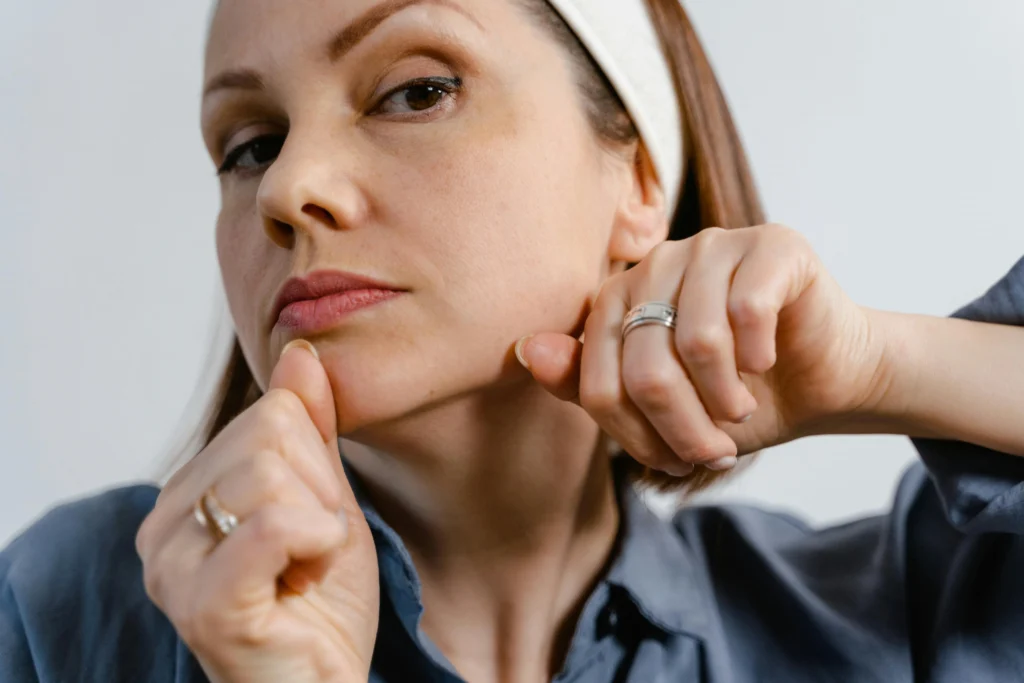
Face fat is body fat. Body fat is stored energy. The only way to lose it is to be in a calorie deficit long enough for your body to burn it.
How it works: Your body decides where to take fat from first. For some people, the face is first to lean out. For others, it’s last. You don’t get to choose.
The number you need to know: Most people start seeing noticeable face fat reduction when they reach 18–22% body fat (women) or 10–15% body fat (men).
| Body Fat % (Women) | Face Appearance |
| 30%+ | Usually round, full cheeks |
| 25–30% | Some definition starting |
| 20–25% | Jawline emerging |
| 18–22% | Clear jawline, cheekbone definition |
| Under 18% | Very lean face (may look gaunt) |
| Body Fat % (Men) | Face Appearance |
| 25%+ | Round, soft, double chin common |
| 20–25% | Some definition, double chin reducing |
| 15–20% | Jawline visible |
| 10–15% | Chiseled, hollow cheeks possible |
| Under 10% | Very lean, often looks older |
Real-talk verdict: If your body fat is above 25% (women) or 20% (men), losing face fat means losing body fat. No shortcuts.
Poor sleep causes facial puffiness through several mechanisms:
| Sleep Issue | Effect on Face |
| Cortisol elevation | Increases water retention |
| Poor lymphatic drainage | Fluid collects in face (gravity while lying down) |
| Increased inflammation | Puffiness, redness, bloated appearance |
| Dehydration from mouth breathing | Paradoxical puffiness (body holds water) |
The fix: 7–9 hours of quality sleep. Consistent bed and wake times. Elevate your head slightly with an extra pillow to prevent fluid pooling in your face overnight.
How long until you see a difference: 3–7 days of good sleep reduces puffiness significantly.
Salt makes you hold water. Water shows up in your face first because facial skin is thin and loose.
How it works: Sodium attracts water. High sodium intake = your body holds onto extra fluid to maintain balance. That fluid settles in soft tissues – including your face.
The numbers:
High-sodium foods to reduce:
| Food | Sodium (approx) |
| Canned soup (1 can) | 1,500–2,000mg |
| Frozen pizza (1 slice) | 600–900mg |
| Fast food burger | 800–1,200mg |
| Soy sauce (1 tbsp) | 900mg |
| Deli meat (2 slices) | 400–600mg |
| Instant ramen (1 pack) | 1,500–2,000mg |
Quick fix: Drink more water. Sounds counterintuitive, but proper hydration helps your body flush excess sodium.
Alcohol is a triple threat for face fat and puffiness:
| Effect | What Happens |
| Dehydration | Body holds water in face to compensate |
| Inflammation | Facial redness, bloating |
| Poor sleep | Cortisol increases, face looks puffy in morning |
| Empty calories | Contributes to overall fat gain |
The experiment: Take a “before” photo of your face. Stop drinking alcohol for 30 days. Take an “after” photo. Most people see dramatic reduction in facial puffiness and redness.
Real-talk verdict: You don’t need to quit forever. But if you drink 3–4 nights per week, your face will look puffier than it needs to be.
This is not “face exercise.” You cannot lose fat by chewing. But you can develop your masseter muscles (jaw muscles), which can create a sharper, more defined jawline appearance.
What helps:
What does NOT help:
Warning: Over-chewing can cause masseter hypertrophy (overdeveloped jaw muscles), which makes your face look wider and squarer. For most people, this is not desirable. Stick to normal chewing during meals. Don’t add extra exercise.
High-glycemic carbs (white bread, sugar, soda, pastries) spike insulin. Insulin is a fat-storage hormone. Chronically high insulin = more fat storage everywhere, including your face.
What to cut:
| High-Glycemic Carbs | Better Swap |
| White bread | Whole grain or sourdough |
| Sugary cereal | Oatmeal with berries |
| Soda, sweetened drinks | Water, sparkling water, unsweetened tea |
| Candy, cookies | Fruit, dark chocolate (70%+) |
| White rice | Brown rice, quinoa, cauliflower rice |
What to keep: Complex carbs (vegetables, legumes, whole grains) are fine. They don’t spike insulin the same way.
Dehydration causes your body to hold water (paradoxical puffiness). Proper hydration tells your body it’s safe to release stored water.
How much water: A good rule is to drink enough so your urine is pale yellow. For most people, that’s 2–3 liters per day.
Timing matters: Stop drinking 1–2 hours before bed to prevent middle-of-the-night bathroom trips and morning facial puffiness (water settling in face while lying down).
Does water flush “toxins” from face fat? No. That’s nonsense. But proper hydration does reduce unnecessary water retention, which makes your face look leaner.
| Product/Method | Why It’s Useless |
| Face rollers (jade, ice, gua sha) | Temporary lymphatic drainage (30 min effect). Does not burn fat. |
| Face exercise devices | No evidence. Cannot spot-reduce fat. Can cause wrinkles. |
| Facial “slimming” creams | Cannot penetrate to fat layer. At best, temporary tightening from caffeine or menthol. |
| Ice water face dunks | Temporary vasoconstriction (less redness). Does nothing to fat. |
| Face masks with “fat burning” ingredients | Gimmick. Fat cells are deep under skin. |
| Cool sculpting for face | Dangerous. Can cause facial asymmetry, nerve damage, paradoxical fat growth. |
| Buccal fat removal surgery | Works but permanent. Can make you look older as natural facial fat decreases with age. |
The only exception: Gua sha and facial massage can reduce morning puffiness temporarily by moving lymphatic fluid. But it does not remove fat. Think of it as a 30-minute fix, not a solution.
| Approach | Time to Noticeable Change |
| Reduce sodium + hydrate | 2–5 days (reduces puffiness, not fat) |
| Fix sleep | 3–7 days (reduces puffiness) |
| Stop alcohol | 7–14 days (reduces puffiness + inflammation) |
| Calorie deficit (500/day) | 4–8 weeks (loses actual fat) |
| Full body fat reduction (5% loss) | 8–12 weeks (depends on starting point) |
| Genetics-dependent “last place” loss | 3–6 months (if face is your stubborn area) |
Real-talk timeline: If you are overweight (body fat above 30% women / 25% men), expect 3–6 months of consistent calorie deficit before your face leans out significantly. If you are already lean (body fat below 25% women / 18% men) but still have a round face, that’s likely genetics. You may not lose more face fat without becoming underweight (not recommended).
A double chin is not always body fat. Other causes:
| Cause | Solution |
| Body fat | Calorie deficit |
| Low hyoid bone (genetic) | Cannot change without surgery (neck lift, chin lipo) |
| Weak jawline (recessed chin) | Cannot change without surgery or filler |
| Poor posture (“tech neck”) | Chin tucks, neck stretches, posture correction (small effect) |
| Age-related skin laxity | Cannot change without procedures (NeckTite, ultherapy, surgery) |
Neck exercises (chin tucks, neck rotations) have very limited evidence. They strengthen neck muscles but do not remove fat or tighten loose skin. A 2014 study found that neck exercises had no significant effect on double chin appearance compared to diet alone.
The one exception: Kybella (deoxycholic acid injection) dissolves fat under the chin. It works. It’s expensive (
1,200–
1,200–2,400 per session, usually 2–4 sessions). It causes significant swelling for 2–4 weeks. Results are permanent.
Expected result: Less morning puffiness. Face may look slightly leaner due to less water retention.
Expected result: Scale drops. Clothes fit better. Face changes still subtle.
Expected result: Some face fat reduction visible in photos.
| Problem | Adjustment |
| No scale weight loss | Reduce calories by another 150/day OR increase steps by 3,000/day |
| Scale weight down but face same | Patience. Face may be your stubborn area. Continue for 8–12 weeks. |
| Puffy face persists | Check sodium again. Alcohol? Sleep? |
No. Zero evidence. You cannot spot-reduce fat. Face exercises may even create wrinkles from repeated skin folding. Save your time.
Genetics. Your body has a “fat loss order” that is individual. For some people, the face is first. For others, it’s the belly. For others, it’s the face and arms. You cannot change this. All you can do is keep losing overall body fat until your body finally reaches your face.
No. Chewing gum works your masseter muscles, not fat. In some people, over-chewing leads to masseter hypertrophy (bulkier jaw muscles), which makes the lower face look wider – the opposite of what most people want.
Sometimes yes. Facial fat contributes to a youthful appearance. Very lean faces (below 18% body fat for women, under 10% for men) often look gaunt, hollow, and older. There’s a sweet spot. Don’t chase “as lean as possible.”
Yes. High cortisol (chronic stress) causes fat storage in the face and neck (“moon face”). High estrogen can also cause fluid retention and facial puffiness. Hypothyroidism causes generalized puffiness (myxedema). If you have unexplained facial fullness with fatigue, weight gain, or irregular periods, see a doctor.
For most people, no. Buccal fat pads are deep cheek fat that naturally decreases with age. Removing them can make you look older in your 30s and 40s. It’s also irreversible. Many celebrities who had buccal fat removal in their 20s now look gaunt and prematurely aged. Think carefully.
Do not compare your face to a model’s airbrushed, dehydrated, surgically enhanced, perfectly lit photo.
You cannot spot-reduce face fat. Every product, device, or exercise promising otherwise is lying to you.
But you can lose face fat by losing overall body fat. And you can reduce facial puffiness quickly by fixing sleep, hydration, sodium, and alcohol.
The honest hierarchy of what works:
| Effectiveness | Method |
| Works 100% | Calorie deficit, reducing body fat percentage |
| Works moderately | Reducing sodium, fixing sleep, stopping alcohol |
| Works temporarily (hours) | Gua sha, facial massage, cold water (lymphatic drainage) |
| Does not work | Face exercises, fat-burning creams, rollers for fat loss |
If your face is still round at a healthy body fat percentage, that’s your face. That’s genetics. That’s bone structure. There is nothing wrong with it. The beauty standard that everyone must have a hollow-cheeked, chiseled-jawline face is recent, unrealistic, and often surgically created.
Focus on health. Lower your body fat if you need to for overall health. Reduce puffiness for a leaner look. But don’t chase a face that nature didn’t give you. You’ll drive yourself crazy – and waste a lot of money.