
Live strong. Eat wise. Feel alive
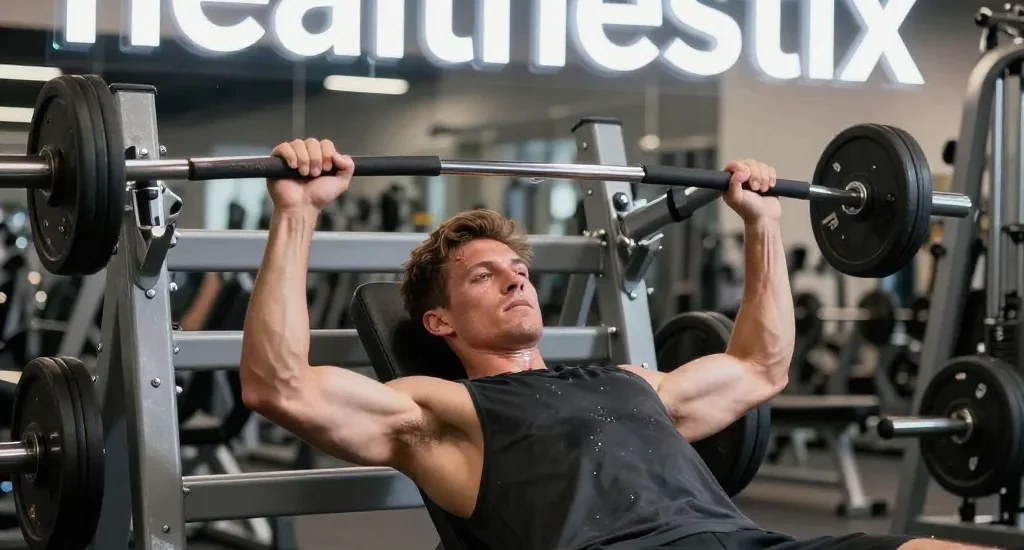
Chest day. Monday. International Bench Press Day.
You walk into the gym and every bench is taken. Guys are pumping out reps, arching their backs, yelling through their last rep. It’s a ritual.
But here’s the truth: most people train their chest wrong.
They bench heavy with terrible form. They ignore the upper chest. They do endless sets of the same exercise. And then they wonder why their chest looks flat instead of full.
A truly great chest day isn’t complicated. But it requires intention, variety, and proper execution whether you’re in a gym or your living room.
This guide gives you the real, no-BS breakdown of the best chest exercises for strength and muscle growth, how to program them, and sample workouts for every situation.
Your pectoralis major (chest muscle) has two heads:
| Head | Location | Function | Best Trained By |
| Clavicular (upper chest) | Top, near collarbone | Pushing upward, shoulder flexion | Incline presses, decline push-ups (feet elevated) |
| Sternal (lower/mid chest) | Main part, from sternum | Pushing forward, adduction | Flat and decline presses, standard push-ups |
Why this matters: If you only do flat bench press, you’re neglecting your upper chest. An underdeveloped upper chest makes your chest look flat from the side even if you’re strong. For a full, balanced chest, you need exercises that target both heads.
Best for: Overall strength and power
Muscles worked: Mid/lower chest (primary), front delts, triceps
Why it’s great: The king of chest exercises. Allows you to lift the heaviest weight, which drives progressive overload and strength gains.
How to do it right:
Common mistakes:
| Sets | Reps | Goal |
| 4–5 | 5–8 | Strength |
| 3–4 | 8–12 | Hypertrophy (muscle growth) |
Best for: Upper chest development
Muscles worked: Upper chest (primary), front delts, triceps
Why it’s great: Dumbbells allow a longer range of motion and more natural shoulder movement than barbell. Incline angle shifts emphasis to the often-neglected upper chest.
How to do it right:
Pro tip: Most people go too heavy and lose range of motion. Lower the weight. Feel the stretch.
| Sets | Reps | Goal |
| 3–4 | 8–12 | Hypertrophy |
Best for: Balanced strength and muscle growth
Muscles worked: Mid/lower chest, stabilization muscles
Why it’s great: Fixes left-right imbalances. Allows a deeper stretch than barbell. Safer to failure (you can drop dumbbells).
How to do it right:
| Sets | Reps | Goal |
| 3–4 | 8–12 | Hypertrophy |
Best for: Chest contraction and width
Muscles worked: Entire chest (fly motion stretches and contracts differently than pressing)
Why it’s great: Flyes train the chest in the transverse adduction plane (bringing arms together), which is different from pressing. This adds width and shape.
How to do it right (cable):
How to do it right (dumbbell):
Warning: Flyes are easy to do with poor form. Lighter weight + perfect form > heavy weight + shoulder injury.
| Sets | Reps | Goal |
| 3 | 10–15 | Contraction and pump |
Best for: Lower chest emphasis (good for filling out the bottom of your chest)
Muscles worked: Lower chest (sternal head), triceps
Why it’s great: For people whose upper chest overpowers their lower chest, decline can balance them out. Also easier on shoulders for some people.
How to do it right:
Alternatives: Decline push-ups (feet elevated) if no decline bench available.
| Sets | Reps | Goal |
| 3 | 8–12 | Hypertrophy |
Best for: Accessible chest training anywhere
Muscles worked: Mid/lower chest, triceps, front delts
Why it’s great: No equipment. Multiple variations. Builds relative strength.
How to do it right:
Progression: When 20+ reps is easy, move to harder variations.
Best for: Upper chest emphasis (bodyweight version of incline press)
Muscles worked: Upper chest (clavicular head), front delts
How to do it right:
Difficulty adjustment: Lower feet elevation = easier. Higher elevation = harder.
| Sets | Reps | Goal |
| 3–4 | 8–15 | Hypertrophy |
Best for: Inner chest and triceps emphasis
Muscles worked: Inner chest (more contraction), triceps (major)
How to do it right:
Difficulty: Harder than standard push-up. If too hard, start with knees on ground.
| Sets | Reps | Goal |
| 3 | 6–12 | Strength and triceps |
Best for: Outer chest stretch
Muscles worked: Chest overall (wider grip shifts emphasis slightly)
How to do it right:
Warning: Very wide push-ups can stress shoulders. If you feel shoulder pain, narrow your grip.
| Sets | Reps | Goal |
| 3 | 10–15 | Chest width |
Best for: Lower chest and triceps (bodyweight equivalent of decline press)
Muscles worked: Lower chest (sternal head), triceps
How to do it right (for chest emphasis):
No dip bars? Use the backs of two sturdy chairs (facing each other). Or a counter corner. Or a park bench.
| Sets | Reps | Goal |
| 3 | 6–12 | Lower chest and triceps |
| Exercise | Equipment | Best For | Difficulty | Upper Chest Emphasis |
| Barbell bench press | Barbell + bench | Max strength | Intermediate | Low |
| Incline dumbbell press | Dumbbells + incline bench | Upper chest | Intermediate | High |
| Flat dumbbell press | Dumbbells + bench | Balanced growth | Beginner-Intermediate | Medium |
| Cable crossover | Cable machine | Contraction | Intermediate | Variable |
| Decline barbell press | Barbell + decline bench | Lower chest | Intermediate | Low |
| Standard push-up | None | Accessibility | Beginner | Low |
| Decline push-up | Chair or couch | Upper chest (bodyweight) | Beginner-Intermediate | High |
| Diamond push-up | None | Inner chest, triceps | Intermediate | Low |
| Wide push-up | None | Outer chest stretch | Intermediate | Low |
| Dips | Parallel bars or chairs | Lower chest | Intermediate-Advanced | Low |
| Component | Why | Examples |
| Heavy compound | Strength and overall mass | Barbell bench press, weighted dips |
| Upper chest movement | Fullness and balance | Incline press, decline push-ups |
| Stretch/fly movement | Width and shape | Cable crossover, dumbbell fly |
| Finisher (optional) | Pump and endurance | Push-ups to failure |
| Rep Range | Goal |
| 1–5 | Strength (less muscle growth per set) |
| 6–12 | Hypertrophy (optimal for muscle growth) |
| 12–20 | Endurance + pump (less growth per set but adds volume) |
Sweet spot for most people: 8–12 reps for 3–4 sets per exercise.
| Exercise | Sets | Reps | Rest |
| Barbell bench press | 4 | 8–10 | 90s |
| Incline dumbbell press | 3 | 10–12 | 75s |
| Cable crossover (low to high) | 3 | 12–15 | 60s |
| Dips (weighted if possible) | 3 | 8–12 | 75s |
| Push-ups (finisher) | 2 | To failure | 45s |
Total time: 40–50 minutes
| Exercise | Sets | Reps | Rest |
| Barbell bench press | 5 | 5 | 120–150s |
| Incline barbell press | 4 | 6–8 | 90s |
| Dips (weighted) | 4 | 6–8 | 90s |
| Decline push-ups | 3 | 10–12 | 60s |
Total time: 35–45 minutes
| Exercise | Sets | Reps | Rest |
| Decline push-up (feet on chair) | 4 | 10–15 | 60s |
| Diamond push-up | 3 | 6–12 | 60s |
| Wide push-up | 3 | 12–15 | 60s |
| Standard push-up (slow, 3-second lowering) | 3 | To failure | 60s |
| Dips between chairs | 3 | 6–12 | 75s |
Progression: Add a backpack with books or water bottles for weight.
Total time: 25–35 minutes
| Exercise | Sets | Reps | Rest |
| Band chest press (anchor behind back) | 4 | 12–15 | 60s |
| Band fly (anchor behind) | 3 | 15 | 60s |
| Push-up (feet elevated) | 4 | 10–15 | 60s |
| Band crossover (anchor high) | 3 | 15–20 | 60s |
Total time: 30 minutes
| Mistake | Why It’s Bad | Fix |
| Flaring elbows on bench press | Shoulder impingement risk | Keep elbows at 45–75 degrees |
| Bouncing bar off chest | Reduces muscle tension, injury risk | Touch lightly, pause for 1 second |
| Not retracting shoulder blades | Rounds shoulders forward, uses front delts more | Squeeze shoulder blades together before every rep |
| Half reps (not full range of motion) | Less muscle growth | Lower bar to chest (or dumbbells to armpits) |
| Only doing flat bench | Neglects upper chest | Add incline work |
| Too much weight, poor form | Injury, less chest activation | Lower weight. Feel the chest work. |
| No progressive overload | Plateau | Track weights. Add 2.5–5 lbs or 1 rep each week. |
| Training chest 4x per week | Overtraining, poor recovery | 1–2x per week max (muscles need 48–72 hours recovery) |
| Method | How to Do It | Example |
| Add weight | Increase load when you hit target reps | 185 lbs for 10 reps → 190 lbs for 8+ reps |
| Add reps | Increase reps before increasing weight | 185 lbs for 8 reps → 185 lbs for 10 reps |
| Add sets | Increase volume over time | 3 sets → 4 sets |
| Reduce rest | Increase density | 90 sec rest → 75 sec rest |
| Improve form | Better mind-muscle connection | Slower negatives, pause at bottom |
| Change variation | New stimulus (mechanical tension) | Flat barbell → Incline dumbbell |
The rule: Track everything. If you did 8 reps of 185 last week, do 9 reps or 190 this week. If you stay the same for 3+ weeks, change something.
| Training Level | Frequency | Why |
| Beginner | 1x per week | Recovery is faster but technique matters more |
| Intermediate | 1–2x per week | More volume = more growth, but spread across days |
| Advanced | 2x per week | Higher frequency improves protein synthesis |
Example weekly splits:
| Split Type | Chest Frequency | Example Days |
| Bro split | 1x | Monday: Chest, Tuesday: Back, Wednesday: Legs, Thursday: Shoulders, Friday: Arms |
| Push/Pull/Legs | 2x | Monday: Push (chest/shoulders/tris), Thursday: Push |
| Upper/Lower | 2x | Monday: Upper (chest/back/shoulders/arms), Thursday: Upper |
Real-talk verdict: Most people grow best with 2x per week chest training, but with volume split across days (e.g., 6–8 total hard sets per session instead of 12–15 in one day).
| Step | What to Do | Why | |
| 1 | Light cardio | Jumping jacks, arm circles, light jog | Increase blood flow |
| 2 | Dynamic stretches | Arm crosses, shoulder rotations | Prepare shoulder joints |
| 3 | Activation | Band pull-aparts, scarecrows | Wake up rear delts and rotator cuff |
| 4 | Light warm-up sets | 50% working weight x 10 reps | Prepare nervous system |
| Stretch | How Long | Why |
| Doorway chest stretch | 30 seconds per side | Open chest, prevent tightness |
| Cross-body shoulder stretch | 30 seconds per side | Shoulder mobility |
| Child’s pose (arms forward) | 60 seconds | Upper back and lat stretch |
| Time Frame | What to Expect |
| 4–6 weeks | Improved strength, mind-muscle connection |
| 8–12 weeks | Visible muscle definition (if diet supports) |
| 6 months | Noticeable size increase |
| 1+ years | Significant chest development |
Genetics play a huge role. Some people build chest easily. Others struggle. Stay consistent.
Most likely: your front delts and triceps are taking over. Fix it by:
Yes but it’s harder and slower than with weights.
Push-ups build relative strength (strength relative to body weight). To build absolute size, you need to increase resistance. Progress through harder variations (decline, diamond, one-arm) or add weight (backpack, vest).
Limitation: Push-ups won’t build the same lower chest thickness as dips or decline presses. But for most people’s goals, push-ups are sufficient if progressed correctly.
Yes train larger muscle groups first when you’re fresh.
| Order | Why |
| Chest first (large muscle) | Requires most energy |
| Shoulders second (smaller) | Secondary in pressing movements |
| Triceps last (smallest, assist in chest exercises) | If fresh, they’ll fail before chest |
If you train triceps before chest, your bench press will suffer.
| Goal | Exercises | Total Sets |
| Strength | 3–4 | 12–16 |
| Hypertrophy | 4–5 | 15–20 |
| Maintenance | 2–3 | 8–12 |
More exercises don’t equal more growth. Quality > quantity. Pick 3–5 exercises, execute them well, and progress each week.
Incline dumbbell press (30–45 degrees). Decline push-ups (feet elevated) for bodyweight. Upper chest is notoriously hard to grow for many people. Prioritize it early in your workout when you’re fresh.
Yes but differently than men. Women have breasts and less testosterone, so chest muscle isn’t as visible. But developing your pectoral muscles can:
Women should absolutely train chest just with realistic expectations about appearance.
Stop the exercise that hurts. Possible causes and fixes:
| Cause | Fix |
| Elbows flared too wide | Tuck elbows to 45–75 degrees |
| Bar lowering too high (toward neck) | Lower bar to lower sternum |
| Not retracting shoulder blades | Squeeze shoulder blades together |
| Going too deep on dips | Don’t dip lower than 90 degrees elbow |
| Underlying impingement or tendinitis | See a physiotherapist. Stop pressing for 1–2 weeks. |
Never push through shoulder pain. It doesn’t get better. It gets worse.
Chest day doesn’t need to be complicated. It needs to be intentional.
The formula is simple:
Progress each week. Track your weights. Prioritize form over ego. And for the love of everything retract your shoulder blades.
Whether you’re in a gym with a barbell or in your living room with push-ups, the principles are the same: tension, range of motion, progressive overload, and consistency.
Do that, and your chest will grow.
Skip the fluff. Stop the half-reps. And never skip incline press again.
Your upper chest will thank you.