Live strong. Eat wise. Feel alive

You step on the scale. It says 150 pounds. Is that good? Bad? Who knows?
Two people can weigh exactly the same and look completely different. One has visible abs and a chiseled jawline. The other is soft, round, and struggling with their health.
The difference isn’t weight. It’s body fat percentage.
Here’s the truth: the scale is a liar. It doesn’t tell you how much of you is muscle, bone, water, or fat. You can lose fat, gain muscle, stay the same weight, and look dramatically better. The scale would tell you nothing changed.
Body fat percentage tells you the real story. It’s a better predictor of health than BMI, better than weight, and more honest than any number on a scale.
This guide gives you the real, no-BS breakdown of healthy body fat ranges by age and sex, exactly how to measure it (at home and professionally), and why “healthy” looks different on everyone.
Body fat percentage is the total mass of your fat divided by your total body mass.
The formula:
(Fat Mass ÷ Total Body Mass) × 100 = Body Fat Percentage
Example: A 150-pound person with 30 pounds of fat has 20% body fat (30 ÷ 150 = 0.2 × 100 = 20%).
Your body needs some fat to survive. This is called essential fat:
| Sex | Essential Fat Minimum | Below This Is Dangerous |
| Women | 10–13% | Hormone disruption, bone loss, fertility issues |
| Men | 2–5% | Hormone disruption, immune suppression |
Below essential fat levels is not healthy. It’s not “elite.” It’s starvation.
Healthy ranges change as you age. Older adults need slightly more body fat for hormone function and energy reserves.
| Age | Essential Fat | Athletes | Fit | Acceptable | Obese |
| 20–29 | 10–13% | 14–20% | 21–24% | 25–32% | 33%+ |
| 30–39 | 10–13% | 14–21% | 22–25% | 26–33% | 34%+ |
| 40–49 | 10–13% | 15–22% | 23–26% | 27–34% | 35%+ |
| 50–59 | 10–13% | 16–23% | 24–27% | 28–35% | 36%+ |
| 60+ | 10–13% | 17–24% | 25–28% | 29–36% | 37%+ |
What these numbers mean:
Sweet spot for most women: 22–28% (fit to acceptable range)
| Age | Essential Fat | Athletes | Fit | Acceptable | Obese |
| 20–29 | 2–5% | 6–13% | 14–17% | 18–24% | 25%+ |
| 30–39 | 2–5% | 7–14% | 15–18% | 19–25% | 26%+ |
| 40–49 | 2–5% | 8–15% | 16–19% | 20–26% | 27%+ |
| 50–59 | 2–5% | 9–16% | 17–20% | 21–27% | 28%+ |
| 60+ | 2–5% | 10–17% | 18–21% | 22–28% | 29%+ |
What these numbers mean:
Sweet spot for most men: 15–22% (fit to acceptable range)
| Age-related change | Effect on body fat |
| Muscle loss (sarcopenia) | Same weight = higher fat percentage |
| Hormone decline (testosterone, estrogen) | Fat storage increases |
| Reduced activity | Lower calorie burn |
| Metabolic slowdown | Fat accumulates easier |
Important: Age-related fat gain is not inevitable. Strength training preserves muscle. Active older adults can maintain body fat percentages similar to people 20 years younger.
How it works: BMI = weight (kg) ÷ height (m²)
Why it’s bad: BMI cannot distinguish between muscle and fat.
| Person | Weight | Height | BMI | Body Fat % | Health Status |
| Sedentary overweight person | 220 lbs | 5’10” | 31.6 | 35% | Obese (accurate) |
| Bodybuilder | 220 lbs | 5’10” | 31.6 | 12% | Lean (BMI says obese – wrong) |
Real-talk verdict: BMI is useful for population studies, not individuals. If you have any muscle, ignore BMI.
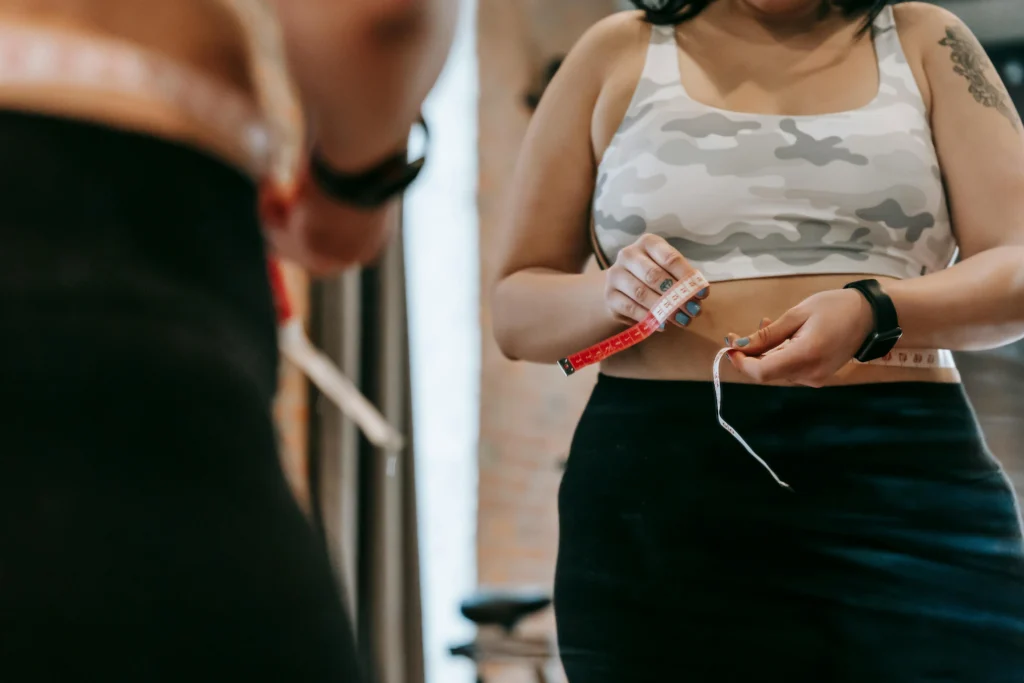
How it works: Uses circumference measurements. No special equipment needed – just a measuring tape.
For men: Measure neck and waist. For women: measure neck, waist, and hips.
Step-by-step (men):
Step-by-step (women):
Accuracy: Within 3–4% of lab methods. Good enough for tracking changes over time.
Where to find calculator: Search “Navy body fat calculator” – many free options.
How it works: Pinch fat at specific body sites, measure thickness with calipers, plug into formula.
Sites to measure:
| Men | Women |
| Chest | Triceps |
| Abdomen | Suprailiac (hip bone) |
| Thigh | Thigh |
Accuracy: Within 3–5% of lab methods when done correctly. Requires practice.
Best calipers for home: Accu-Measure (cheap, ~
10)orLange(professional,
10)orLange(professional, 200)
Pro tip: Have the same person measure you each time. Different people pinch differently.
How it works: Low-dose X-ray scans your entire body. Measures fat, muscle, and bone separately.
| What DEXA Tells You | Why It Matters |
| Total body fat % | Overall health |
| Visceral fat (organ fat) | Best predictor of metabolic disease |
| Lean mass (muscle) per body part | Identifies muscle imbalance |
| Bone density | Osteoporosis risk |
Cost: $50–150 per scan
Where to get one: Fitness centers, medical imaging centers, some gyms. Search “DEXA scan near me.”
Accuracy: Within 1–2%. Gold standard.
How often: Every 3–6 months if tracking progress. No need to scan more often.
How it works: You sit in an egg-shaped chamber. Air pressure changes measure your body volume. From volume and weight, body density – and therefore body fat – is calculated.
Accuracy: Within 2–3% of DEXA
Cost: $50–100 per session
Where to find: Universities, some fitness centers, sports performance labs.
| Method | Problem |
| Bioelectrical impedance scales (home scales) | Affected by hydration, time of day, food intake. Can vary 5–10% in one day. Useless for tracking. |
| Handheld body fat devices | Same problem as scales. Even worse accuracy. |
| Smart watches with body fat % | Completely made up. Not real. |
| Visual estimation (looking in mirror) | Subjective. Your eyes lie. |
| Type | Location | Health Risk |
| Subcutaneous fat | Under skin (pinchable) | Low – mostly cosmetic |
| Visceral fat | Around organs (inside belly) | High – linked to diabetes, heart disease, inflammation |
The problem: You can have a “healthy” body fat percentage but dangerous visceral fat levels (common in “skinny fat” individuals).
DEXA scans and MRI can measure visceral fat. Waist circumference is a decent proxy:
| Sex | High-Risk Waist Circumference |
| Women | >35 inches (88 cm) |
| Men | >40 inches (102 cm) |
If your waist is above these numbers, your visceral fat is likely high – regardless of your body fat percentage.
| Person | Weight | BMI | Body Fat % | Real Health Status |
| “Skinny fat” woman | 130 lbs | 22 (normal) | 34% | Overfat. Low muscle, high fat. Metabolic risk. |
| Fit woman | 150 lbs | 26 (overweight by BMI) | 24% | Healthy. Good muscle. No metabolic risk. |
| Obese by both | 200 lbs | 33 (obese) | 40% | High risk. Needs fat loss. |
| Lean man | 170 lbs | 24 (normal) | 18% | Healthy. Good muscle. Minimal risk. |
| Skinny fat man | 150 lbs | 22 (normal) | 25% | Overfat. Low muscle. Higher risk than lean man. |
Key lesson: BMI and weight alone cannot distinguish between “skinny fat” and truly healthy.
Losing body fat is not the same as losing weight. You want to lose fat while keeping muscle.
| Component | Action |
| Calorie deficit | 300–500 below maintenance |
| Protein intake | 1.6–2.2g per kg body weight |
| Strength training | 3–4x per week |
| Cardio | Optional (for deficit, not required) |
| Sleep | 7–9 hours (critical for fat loss) |
| Your Current Body Fat % | Safe Weekly Fat Loss |
| 30%+ | 1–1.5% body weight per week |
| 20–30% | 0.7–1% body weight per week |
| 15–20% | 0.5–0.7% body weight per week |
| Under 15% (men) / Under 22% (women) | 0.5% or less per week |
Example: A 200lb person at 30% body fat (60lb fat) can safely lose 2lb per week. A 170lb person at 18% body fat (30lb fat) should lose 0.8–1.2lb per week max.
| Time Frame | Realistic Body Fat Reduction |
| 1 month | 1–3% (depending on starting point) |
| 3 months | 3–6% |
| 6 months | 5–10% |
| 1 year | 8–15% (if consistent) |
Real-talk truth: Going from 30% to 20% body fat takes most people 6–12 months. Going from 20% to 15% takes another 6–12 months. The leaner you are, the slower fat loss becomes.
Low body fat is not always healthy. Social media has normalized extremely low body fat as “fitness.” It’s not.
| In Women | In Men |
| Missed or irregular periods | Low libido |
| Fertility problems | Erectile dysfunction |
| Hair thinning | Persistent fatigue |
| Constant cold feeling | Mood irritability |
| Bone density loss | Low testosterone |
| Disordered eating patterns | Poor workout recovery |
| Sex | Body Fat % Where Hormones Disrupt |
| Women | Below 17% (some women) to below 12% (all women) |
| Men | Below 8% (some men) to below 5% (all men) |
Real-talk verdict: Unless you compete professionally, you do not need single-digit body fat (men) or teens body fat (women). The health benefits stop around 20% (women) and 15% (men). Below that, you risk hormone disruption for no health gain.
Week 0 (baseline):
Week 4:
Week 8:
Week 12:
Success: Lost 4% body fat in 12 weeks. Lost 2 inches from waist. Lost 10 lbs – mostly fat because waist shrank and weight loss wasn’t extreme.
But abs are mostly genetic. Some people have defined abs at 18% (women) / 15% (men). Others need to be much leaner. Muscle development also matters.
Because bioelectrical impedance is affected by:
Ignore daily readings. Track weekly averages at the same time (morning, after bathroom, before eating/drinking). Even then, accuracy is poor.
Two possibilities:
Yes, if:
For intermediate to advanced lifters at lower body fat, muscle gain and fat loss require separate phases (bulk and cut).
Less accurate. At very high body fat (>35% women, >30% men), circumference formulas underestimate body fat. DEXA or Bod Pod is better for accurate baseline.
Yes. Essential fat for women is 10–13% vs. 2–5% for men. Women’s bodies require extra fat for:
A woman at 15% body fat is equivalent in leanness to a man at 8% body fat. Do not compare your body fat percentage to a man’s.
More often than weekly is useless. Your body doesn’t change that fast.
Body fat percentage is the most honest health metric you can track. It’s better than weight. Better than BMI. Better than how you look in the mirror.
But it’s also imperfect. Home methods are estimates. Even DEXA has error margins. The number itself matters less than the trend over time.
The real questions to ask:
If yes to most of those, your number is fine. Don’t obsess over 1–2%. Don’t chase bodybuilder levels of leanness unless you compete. And definitely don’t compare your percentage to someone on Instagram – their number might be fake, edited, or achieved through unhealthy methods.
Focus on getting into the “fit” or “acceptable” range for your age. Stay there. Build muscle. Eat well. Sleep.
That’s real health. The scale never tells that story. Body fat percentage comes closer.