Live strong. Eat wise. Feel alive
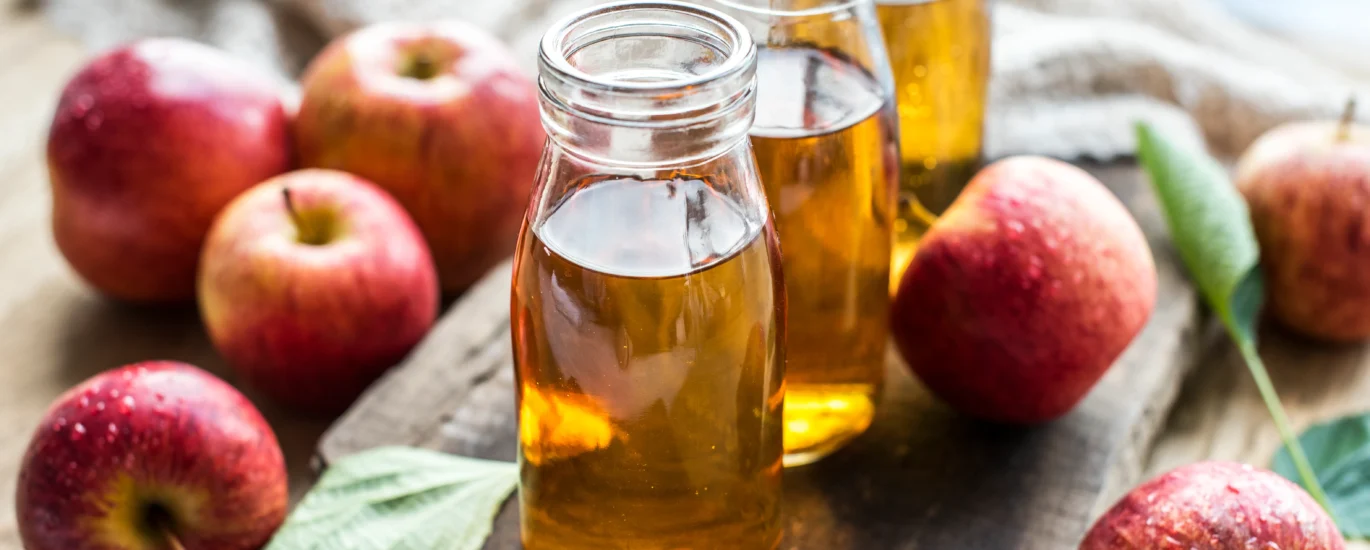
Apple cider vinegar has become one of those things everyone owns but nobody understands.
It sits in your kitchen cabinet. You’ve seen the TikTok videos claiming it melts belly fat. Your aunt swears it cured her acid reflux. And somewhere online, someone is drinking it straight from the bottle like a shot.
Here’s the truth: apple cider vinegar (ACV) is not magic. It won’t change your life overnight. But unlike most internet health trends, ACV actually has real science behind it – for specific things.
This guide gives you the real, no-BS breakdown. Six proven benefits, three complete lies, and exactly how to take it without destroying your teeth or throat.
Apple cider vinegar is made through a two-step fermentation process:
| Step | Process | Result |
| 1 | Crushed apples + yeast | Alcohol (hard cider) |
| 2 | Bacteria added to alcohol | Acetic acid (vinegar) |
The active compound in ACV is acetic acid (about 5–6% of the liquid). That sour taste and strong smell? That’s acetic acid.
“With the mother” means the vinegar is unfiltered and unpasteurized. It contains cloudy strings of protein, enzymes, and friendly bacteria. Does “the mother” add extra benefits? Possibly. But most studies use filtered vinegar and still see results.
This is the most studied benefit. And the evidence is genuinely good.
How it works: Acetic acid blocks the digestion of complex carbohydrates. Less carbohydrate breakdown means less sugar enters your bloodstream. It also improves insulin sensitivity by up to 34% in some studies.
Key research: A 2004 study of 29 people found that consuming vinegar before a high-carb meal reduced post-meal blood sugar by 31% in those with prediabetes and 19% in those with type 2 diabetes.
A 2007 study showed that 2 tablespoons of ACV before bed lowered morning fasting blood sugar by 4–6% in people with type 2 diabetes.
Real-talk verdict: Works. Especially effective for people with insulin resistance, prediabetes, or type 2 diabetes. Not a replacement for medication – a helpful add-on.
Here’s where the hype gets dangerous.
ACV does not “melt fat.” It does not “burn calories while you sleep.” But it may help weight loss through three indirect mechanisms:
| Mechanism | Effect Size |
| Increases satiety (fullness) | Small but real |
| Reduces blood sugar spikes | Moderate |
| Lowers insulin levels (fat-storage hormone) | Small |
Key research: A 2009 study of 175 obese Japanese adults found that those who took 1–2 tablespoons of ACV daily for 12 weeks lost 2–4 pounds more than the placebo group. Nothing dramatic. But real.
A 2018 review concluded that vinegar’s effect on weight loss is “modest” – about 0.5–1 kg (1–2 pounds) over 3 months.
Real-talk verdict: ACV alone will not make you lose significant weight. But combined with a calorie deficit? It’s a helpful tool, not a miracle.
Vinegar has been used as a disinfectant and food preservative for thousands of years. Science agrees: acetic acid kills bacteria, including E. coli and Salmonella.
A 2014 study found that pure ACV killed Mycobacterium tuberculosis (the bacteria causing TB) in lab conditions. Another study showed it reduced Candida (yeast) growth.
Practical uses:
Important: Do not use ACV to treat internal infections (sinus infections, UTIs, pneumonia). That’s not how it works.
Real-talk verdict: Yes for surface bacteria. No for treating internal infections.
This benefit is real in rats. Humans? Mixed.
Rodent studies consistently show that ACV reduces LDL (“bad” cholesterol) and triglycerides while raising HDL (“good” cholesterol).
Human studies are smaller but promising. A 2021 meta-analysis of 9 trials (including over 600 people) found that vinegar consumption significantly reduced total cholesterol and triglycerides. The effect was strongest in people with diabetes or high baseline cholesterol.
Real-talk verdict: Possibly helpful. Not a replacement for statins or diet changes. More human research needed.
PCOS (polycystic ovary syndrome) is driven partly by insulin resistance. Since ACV improves insulin sensitivity, researchers tested it.
A 2013 study of 7 women with PCOS found that taking ACV for 40 days improved insulin sensitivity and restored ovulation in 4 of the 7 women. Small study, but remarkable.
Real-talk verdict: Promising for PCOS, especially with insulin issues. Larger studies needed.
ACV doesn’t directly “clean arteries.” But by improving blood sugar, insulin, and cholesterol – all risk factors for heart disease – it may reduce your overall cardiovascular risk.
A 2006 study found that rats given vinegar had lower blood pressure. Human studies are limited.
Real-talk verdict: A small piece of the heart health puzzle, not the answer.
Truth: No food or drink burns fat. Only a calorie deficit does that. ACV may help you eat slightly less and store slightly less sugar as fat, but drinking vinegar while eating a surplus will cause weight gain, not loss.
Truth: For some people, ACV helps reflux by improving stomach acid production (low stomach acid can cause reflux). For others, it makes reflux dramatically worse. There is no “cure.” Try a small amount. If it burns, stop.
Truth: Most studies use filtered vinegar without the mother and still see benefits. The mother may add probiotics and enzymes, but acetic acid is the main active compound. Filtered ACV is fine.
ACV is safe when used correctly. Misused? It can cause real damage.
| Side Effect | Severity | How to Avoid |
| Tooth enamel erosion | Moderate to severe | Always dilute, use a straw, rinse mouth after |
| Throat burns | Moderate | Never drink undiluted |
| Low potassium (hypokalemia) | Mild to moderate | Don’t exceed 2 tbsp/day |
| Digestive upset | Mild | Start with 1 tsp, increase slowly |
| Medication interactions (diuretics, insulin) | Severe | Consult doctor before starting |
| Slowed stomach emptying (gastroparesis risk) | Moderate (for diabetics) | Monitor symptoms |
| Condition | Why |
| Low potassium | ACV lowers potassium further |
| Chronic kidney disease | Kidneys may not process excess acid |
| Gastroparesis (slow stomach emptying) | ACV makes it slower |
| Active stomach ulcers | Acid burns open tissue |
| Taking digoxin (heart medication) | Low potassium increases toxicity risk |
| Taking insulin or diabetes meds | Risk of dangerously low blood sugar |
| Step | Instruction |
| 1 | Dilute 1–2 tablespoons (15–30ml) in at least 8oz (240ml) water |
| 2 | Never more than 2 tablespoons total per day |
| 3 | Drink through a straw to protect teeth |
| 4 | Rinse mouth with plain water after drinking |
| 5 | Take before meals (for blood sugar) or in morning |
| 6 | Wait 20–30 minutes before brushing teeth (acid softens enamel) |
| Goal | Dose | Timing |
| Blood sugar control | 1–2 tbsp (15–30ml) | Before largest meal |
| Mild weight loss support | 1 tbsp (15ml) | Before lunch and dinner |
| General wellness | 1 tsp (5ml) | Morning |
| PCOS (under doctor guidance) | 2 tbsp (30ml) | Before meals |
| Feature | Good | Avoid |
| Organic | Yes | Not necessary but better |
| “With the mother” | Yes | Not required but preferable |
| Filtered/unfiltered | Unfiltered | Filtered (still works but less beneficial) |
| Acetic acid concentration | 5–6% | Unknown or 0% (“gummies” often have no acetic acid) |
| Form | Liquid | Gummies (most contain almost no actual vinegar) |
Brands to consider: Bragg (original), Dynamic Health, Vermont Village.
Avoid: Most ACV gummies. They’re candy with a tiny drop of vinegar extract.
| Factor | Liquid ACV | Gummies |
| Acetic acid content | 5–6% | Often 0–1% |
| Calories | ~3 per tbsp | 15–30 per gummy |
| Sugar | 0g | 4–8g per serving |
| Tooth damage risk | Moderate (if undiluted) | Low |
| Cost per serving | $0.10–0.20 | $0.50–1.00 |
| Efficacy evidence | Extensive | Almost none |
Verdict: Liquid ACV is cheaper, more effective, and has real evidence. Gummies are overpriced candy for people who can’t handle the taste.
Morning (for blood sugar and metabolism)
Evening (optional – for insulin sensitivity overnight)
Total daily: 2 tbsp maximum
Do this for 12 weeks, then take a 2-week break. Long-term daily use increases side effect risks without added benefit.
Yes, but not indefinitely. Use daily for 8–12 weeks, then take a 2–4 week break. Long-term continuous use can erode enamel and lower potassium.
For some people, yes. The acetic acid may improve stomach acid production and digestion. For others, it causes more bloating (especially if you have gastritis). Try 1 tsp diluted and see how you feel.
Yes, but start with a small amount (1 tsp). Some people feel nausea. If that happens, take with food.
For strict water fasting, yes – ACV has minimal calories but may trigger digestive enzymes. For intermittent fasting, most experts say ACV (diluted) does not break a fast because it has negligible calories and may even support fat oxidation.
Diluted ACV (1 part ACV : 3 parts water) can be used as a toner for acne-prone skin – the antibacterial properties may help. Always patch test first. Never use undiluted on skin – it causes chemical burns.
Two possibilities:
If dizzy occurs, stop and consult a doctor.
Apple cider vinegar is one of the few natural remedies that actually does something. But it does less than influencers claim.
What it definitely does:
What it does NOT do:
If you have prediabetes, PCOS, or struggle with blood sugar swings, ACV is worth adding to your routine – safely, diluted, through a straw.
If you’re healthy, eating well, and just looking for a wellness boost? Save your money. A balanced diet does everything ACV claims to do, without the tooth risk.
Either way, never drink it straight. Your enamel will thank you.