
Live strong. Eat wise. Feel alive
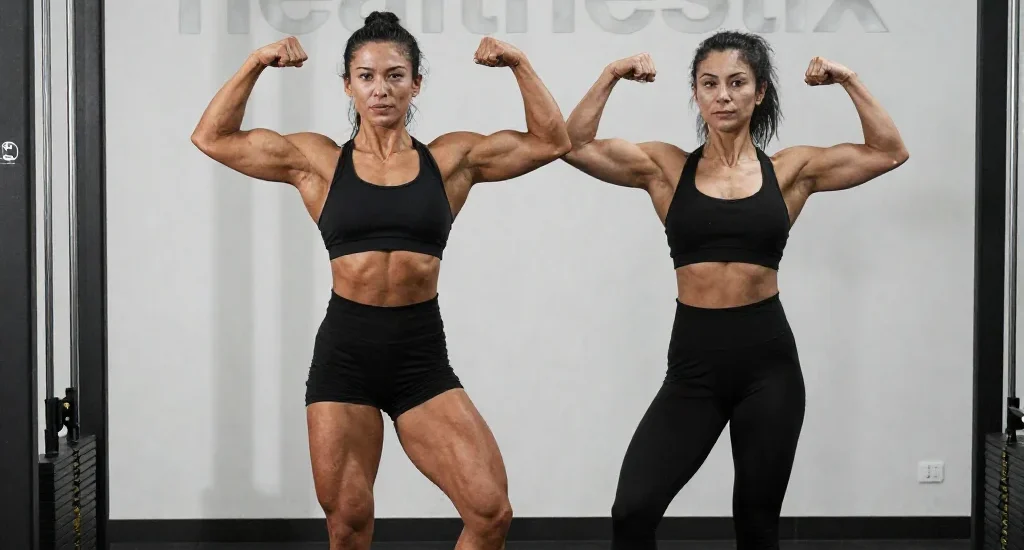
Walk into any gym, and you’ll hear it: “You need weights to build muscle.”
Barbells. Dumbbells. Machines. Cables. The more equipment, the better. Right?
Not exactly.
Here’s the truth nobody tells you: your body doesn’t know the difference between a dumbbell and your own weight. It only knows tension. Resistance. Fatigue.
And your body all 50, 80, or 100+ kilograms of it is plenty of resistance.
Bodyweight exercise (also called calisthenics) built the physiques of ancient Greek athletes, soldiers, and gymnasts. It builds real, usable strength not just gym strength. And you can do it anywhere, for free, with no equipment.
This guide gives you the real, no-BS breakdown of bodyweight training: why it works, how to progress, the best exercises, and how to build true strength without ever touching a barbell.
Let’s kill this myth right now.
| Myth | Truth |
| You need heavy weights for muscle growth | Muscle growth requires mechanical tension and progressive overload which you can achieve with bodyweight |
| Bodyweight is only for endurance | At high reps, yes. But harder variations (archer push-ups, pistol squats) build strength |
| You’ll plateau quickly | Only if you don’t know how to progress. There are dozens of variations for every exercise |
The science: A 2017 study compared bodyweight training to weight training for muscle growth. Results? Both groups gained similar muscle mass when intensity and volume were matched.
The difference? Bodyweight requires more skill and creativity to progress. But it absolutely works.
Before we talk exercises, let’s define strength.
| Type of Strength | What It Means | Bodyweight Example |
| Relative strength | Strength relative to body weight | Pulling your own chin over a bar |
| Absolute strength | Total force produced, regardless of weight | Benching 300 pounds |
| Functional strength | Usable strength for real movement | Climbing, carrying, balancing |
Bodyweight training excels at relative strength and functional strength. You won’t become a powerlifter. But you will be able to move your body through space with control, power, and endurance.
That’s true strength. Not how much you can lift in a controlled environment but what you can do.
Progressive overload means making an exercise harder over time. With weights, you add 5 pounds. With bodyweight, you need other methods.
5 Ways to Make Bodyweight Exercises Harder:
| Method | How to Do It | Example |
| Increase leverage | Move your hands or feet closer together or farther apart | Wide push-up → diamond push-up |
| Change angle | Elevate or lower your body | Incline push-up → decline push-up → handstand push-up |
| Slow down | Increase time under tension | 1-second push-up → 5-second lowering phase |
| Add pauses | Stop at the hardest point | Push-up with 2-second pause at bottom |
| Reduce stability | Use one limb | Two-leg squat → pistol squat (one leg) |
The magic trick: If you can do 20+ reps of an exercise comfortably, it’s too easy. Move to a harder variation. If you can only do 3–5 reps, it’s too hard. Use an easier variation to build volume.
Sweet spot: 5–15 reps per set. That’s the muscle-building range for bodyweight.
These five movements form the foundation. Master these before adding fancy calisthenics skills.
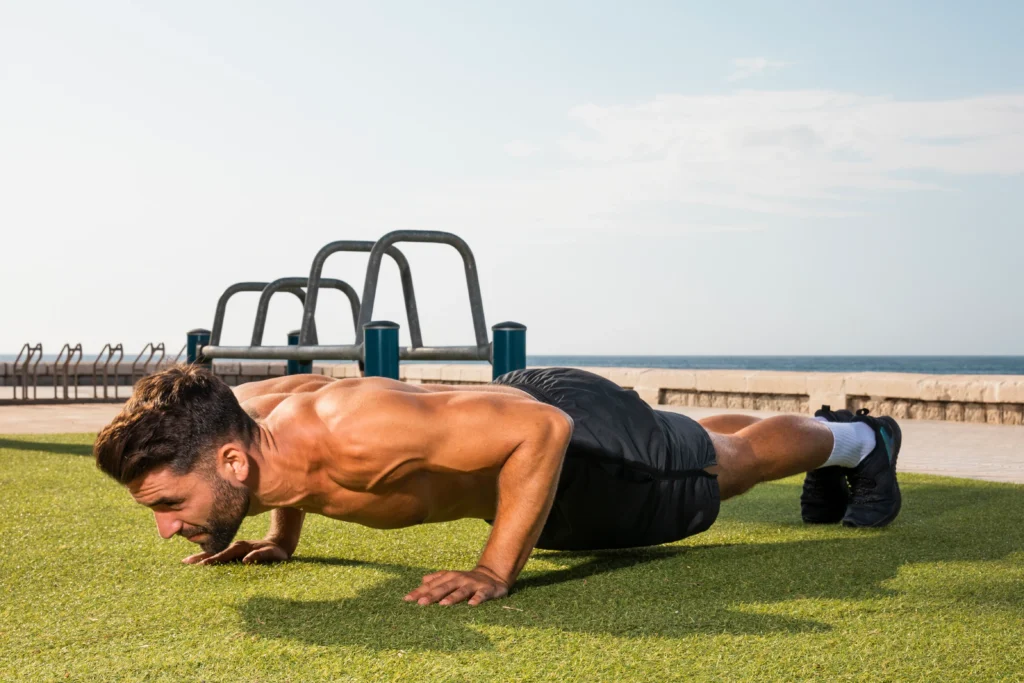
Muscles worked: Chest, shoulders, triceps, core
Difficulty progression (easiest to hardest):
| Level | Variation | Difficulty |
| 1 | Wall push-up | Very easy |
| 2 | Incline push-up (hands on chair) | Easy |
| 3 | Knee push-up | Light |
| 4 | Standard push-up | Moderate |
| 5 | Decline push-up (feet elevated) | Hard |
| 6 | Diamond push-up (hands together) | Harder |
| 7 | Archer push-up (one arm dominant) | Very hard |
| 8 | One-arm push-up | Elite |
Goal: Work up to 3 sets of 15 standard push-ups. Then move to decline or diamond.
Common mistake: Letting hips sag or pike up. Keep a straight line from head to heels.

Muscles worked: Back, biceps, grip, rear shoulders
Difficulty progression:
| Level | Variation | Difficulty |
| 1 | Dead hang (build grip) | Easy |
| 2 | Scapular pull-up (just shoulder blades) | Light |
| 3 | Negative pull-up (jump up, lower slowly) | Moderate |
| 4 | Band-assisted pull-up | Moderate |
| 5 | Standard pull-up | Hard |
| 6 | Wide-grip pull-up | Harder |
| 7 | L-sit pull-up (legs straight out) | Very hard |
| 8 | Archer pull-up | Elite |
No bar? Use a tree branch, playground, doorway pull-up bar, or rings. If nothing is available, do bodyweight rows under a sturdy table.
Goal: Work up to 5 pull-ups. Then 10. Then 15.
Common mistake: Swinging for momentum. Control the movement. Quality over quantity.
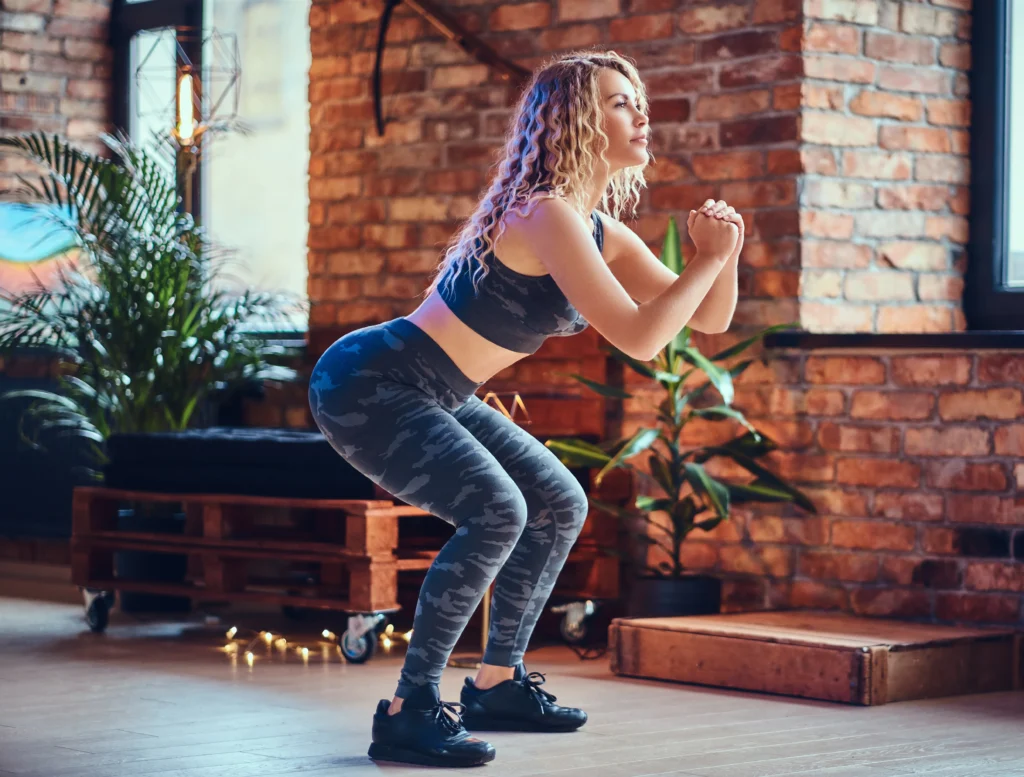
Muscles worked: Quads, glutes, hamstrings, core
Difficulty progression:
| Level | Variation | Difficulty |
| 1 | Box squat (sit to chair) | Easy |
| 2 | Standard bodyweight squat | Light |
| 3 | Jump squat | Moderate |
| 4 | Bulgarian split squat (rear foot elevated) | Hard |
| 5 | Pistol squat (one leg) | Very hard |
| 6 | Weighted pistol squat (hold something heavy) | Elite |
Goal: 3 sets of 20 controlled squats. Then progress to Bulgarian split squats or pistols.
Common mistake: Knees caving inward. Push knees out over toes. Heels on the ground.
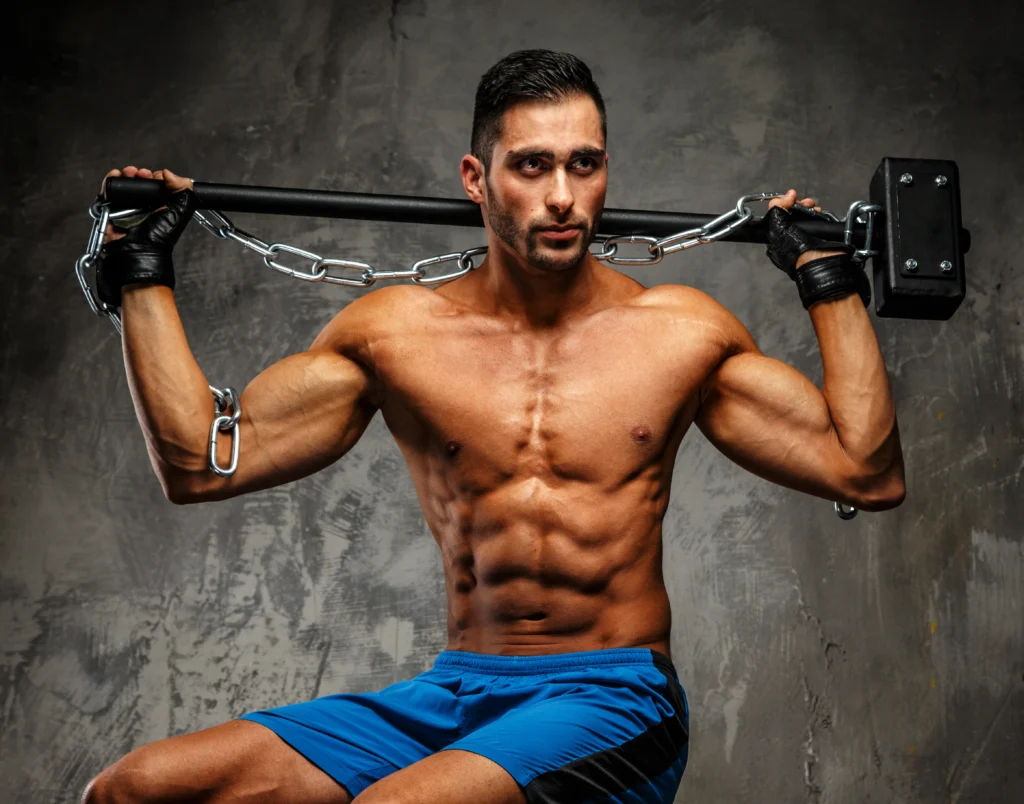
Muscles worked: Hamstrings, glutes, lower back
Challenge: Purely bodyweight hinge movements are hard. Your legs are heavy, but not heavy enough for some people.
Best bodyweight hinge exercises:
| Exercise | Difficulty | How To |
| Glute bridge | Easy | Lie on back, drive hips up |
| Single-leg glute bridge | Moderate | Same, but one leg extended |
| Reverse hyperextension | Moderate | Lie face down on table, lift legs |
| Nordic curl (eccentric) | Very hard | Kneel, lean forward controlled |
No perfect substitute for deadlifts here. But glute bridges and Nordic curls get close.
Goal: 3 sets of 20 glute bridges. Then single-leg.
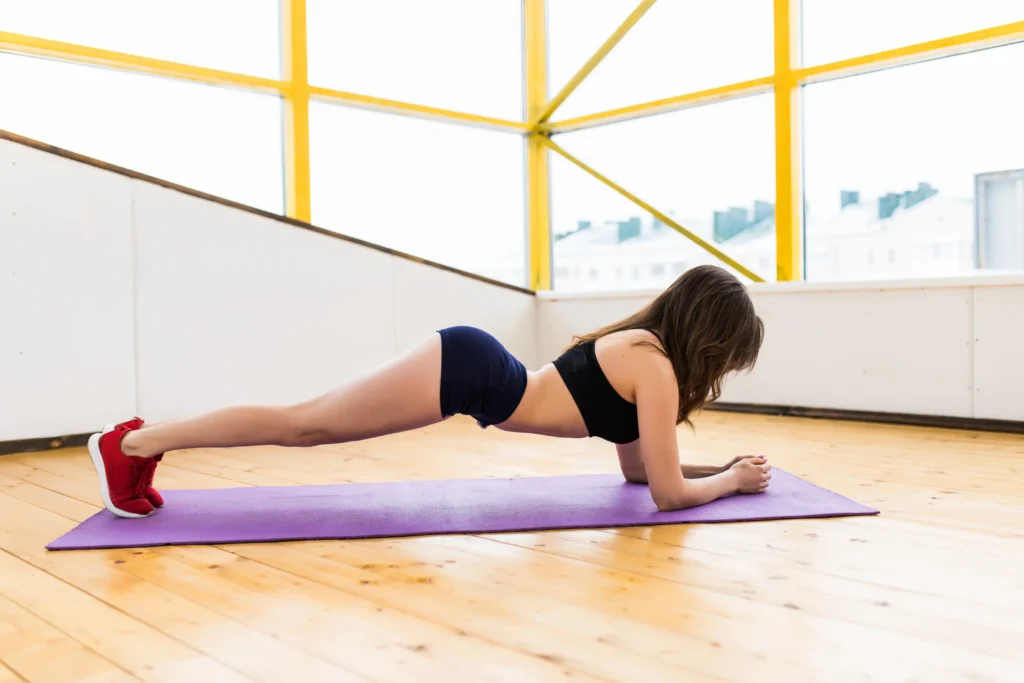
Muscles worked: Entire core (not just abs)
Best bodyweight core exercises:
| Exercise | What It Trains | Difficulty |
| Plank | Anti-extension | Easy to moderate |
| Side plank | Anti-lateral flexion | Moderate |
| Dead bug | Anti-extension + coordination | Light |
| Leg raise | Hip flexion + lower abs | Moderate |
| Hanging leg raise | Same + grip | Hard |
| L-sit | Full core compression | Very hard |
Goal: Hold plank for 60 seconds. Work up to 3 sets of 10 hanging leg raises.
Common mistake: Only doing crunches. Crunches train spinal flexion but real-world core strength is about preventing movement, not creating it. Prioritize planks and leg raises.
| Exercise | Sets | Reps | Rest |
| Incline push-up | 3 | 10–15 | 60s |
| Bodyweight squat | 3 | 15–20 | 60s |
| Glute bridge | 3 | 15 | 60s |
| Plank | 3 | 20–30 seconds | 45s |
| Negative pull-up (or bodyweight row) | 3 | 5 (slow) | 90s |
Frequency: 3x per week (e.g., Monday, Wednesday, Friday)
| Exercise | Sets | Reps | Rest |
| Standard push-up | 4 | 10–15 | 60s |
| Bulgarian split squat | 3 per leg | 8–12 | 60s |
| Pull-up (or band-assisted) | 4 | As many as possible (AMAP) | 90s |
| Single-leg glute bridge | 3 per leg | 12 | 60s |
| Hanging leg raise (or lying leg raise) | 3 | 10 | 60s |
Frequency: 3–4x per week
| Exercise | Sets | Reps | Rest |
| Archer or one-arm push-up progression | 4 | 5–8 per side | 90s |
| Pistol squat progression | 3 per leg | 5–8 | 90s |
| Pull-up | 5 | AMAP (aim for 10+) | 90s |
| Nordic curl (eccentric) | 3 | 5–8 | 90s |
| L-sit | 3 | 10–20 seconds | 60s |
Frequency: 4x per week (upper/lower split or full body)
You don’t need a gym. You don’t need much space.
| Equipment | Cost | Why |
| Pull-up bar (doorway) | $20–30 | Essential for back and biceps |
| Yoga mat or carpet | $10–20 | Comfort for push-ups and planks |
| Resistance bands (optional) | $10–15 | Assist pull-ups or add resistance |
| A chair or stool | Free | Incline push-ups, Bulgarian split squats |
| A wall | Free | Handstand progressions, wall sits |
That’s it. Everything else is your body.
| Factor | Bodyweight | Weights |
| Cost | Free | Expensive (gym or equipment) |
| Accessibility | Anywhere | Requires gym or home setup |
| Leg strength development | Good but limited for maximal strength | Excellent (squats, deadlifts) |
| Upper body strength | Excellent (push-ups, pull-ups, dips) | Excellent |
| Relative strength | Best | Good |
| Absolute strength (max force) | Limited | Best |
| Skill requirement | Higher (need to learn progressions) | Lower (just add weight) |
| Injury risk | Low (natural movements) | Moderate (poor form with heavy weight) |
Real-talk verdict: For most people’s goals looking good, feeling strong, moving well bodyweight is enough. If you want maximal leg size or absolute strength, you’ll eventually need weights. But you can get very, very far with just your body.
Here’s the part nobody talks about.
True strength isn’t just how many pull-ups you can do. It’s:
Bodyweight training teaches you all of that.
There’s no machine to stabilize you. No bench to catch you. No spotter to save you. Just you, gravity, and your own will.
That’s true strength.
Yes. Look at gymnasts or calisthenics athletes. They train almost exclusively with bodyweight. Their physiques speak for themselves.
But you need to train hard. Doing 50 push-ups won’t build much muscle after the first few weeks. You need to progress to harder variations archer push-ups, one-arm push-ups, weighted vests.
| Time Frame | What to Expect |
| 2–4 weeks | Improved endurance, better mind-muscle connection |
| 6–8 weeks | Visible muscle definition (if diet supports it) |
| 12+ weeks | Significant strength gains (more pull-ups, harder variations) |
| 6+ months | Noticeable muscle growth (comparable to weight training) |
Yes but not because of the exercises themselves. Fat loss comes from a calorie deficit. Bodyweight exercises burn calories, which helps create that deficit. But you cannot spot-reduce belly fat. Eat in a deficit, train consistently, and the fat will come off from wherever your genetics decide.
For heart health, yes. Separate from strength training. Bodyweight circuits can get your heart rate up, but dedicated cardio (walking, running, cycling, swimming) is still important. Aim for 150 minutes of moderate cardio per week.
Start here:
| Week | Focus |
| 1–2 | Dead hangs (build grip strength) – 3 sets of 15–30 seconds |
| 3–4 | Scapular pull-ups (just shoulder blade movement) – 3 sets of 8–10 |
| 5–6 | Negative pull-ups (jump up, lower slowly over 5 seconds) – 3 sets of 3–5 |
| 7–8 | Band-assisted pull-ups – 3 sets of as many as possible (AMAP) |
Most people get their first pull-up in 8–12 weeks of consistent work.
Legs are the hardest to train with bodyweight alone. But you have options:
If you eventually want bigger legs, you may need weights. But for functional leg strength and endurance, bodyweight is fine.
Yes safer than weights, in fact. The movements are natural (push, pull, squat, hinge). You can’t drop a barbell on yourself. And you can always use easier variations to match your current strength.
Start with the beginner routine above. Focus on form before adding difficulty.
Yes, but not the same muscles. Use a split:
| Split Type | Example |
| Full body | 3x per week (e.g., Mon/Wed/Fri) |
| Upper/lower | 4x per week (Mon: upper, Tue: lower, Thu: upper, Fri: lower) |
| Push/pull/legs | 6x per week (Push, Pull, Legs, Push, Pull, Legs – rest Sunday) |
Listen to your joints. Bodyweight training is easier on the body than heavy weights, but tendons and ligaments still need recovery.
You don’t need a gym membership. You don’t need dumbbells or a barbell. You don’t need expensive equipment.
You need your body. Gravity. And the willingness to progress.
Bodyweight training builds true strength not just the ability to move weight in a straight line, but the ability to control your own body through space. That’s strength that translates to real life. Carrying groceries. Playing with your kids. Hiking. Climbing. Moving furniture.
Start where you are. Use easier variations. Progress slowly. Don’t compare yourself to someone doing one-arm push-ups on Instagram.
Your only competition is yesterday’s version of you.
One push-up at a time. One pull-up at a time. One squat at a time.
That’s true strength.